Rural Property CCTV: Security for Farms and Country Homes
Why Rural Properties Need a Different Approach
CCTV on a housing estate is straightforward. A few cameras, decent Wi-Fi, mains power everywhere. A farm or rural home is a different job entirely.
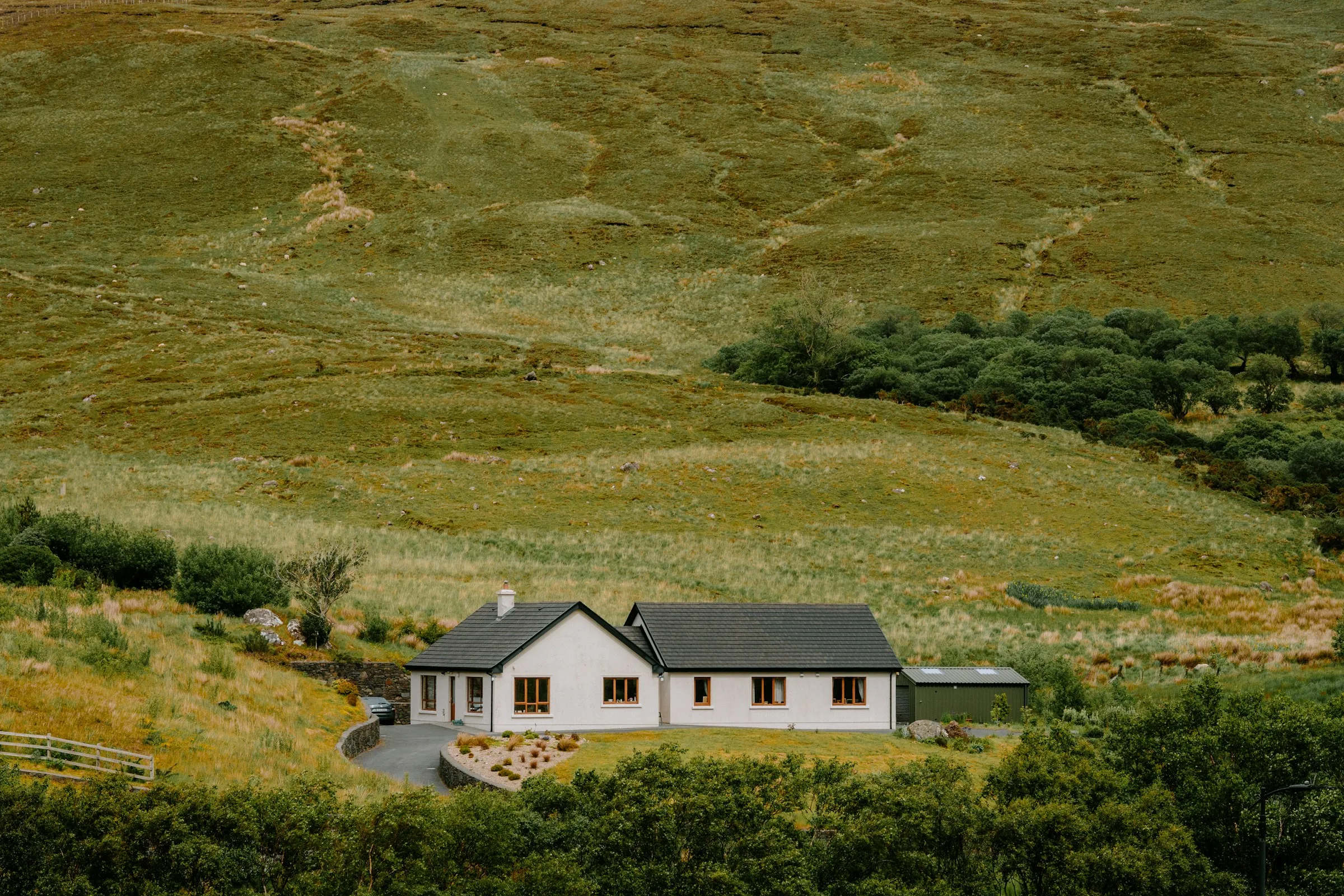
You might be covering a 500-metre driveway, three outbuildings, a fuel tank at the back of a field, and a machinery shed with no electricity. Standard home CCTV systems are not built for this. Rural properties need systems designed around distance, power limitations, and patchy connectivity.
This guide covers what actually works for Irish farms and country homes.
Rural Crime in Ireland: The Real Picture
Rural crime is not a tabloid invention. The IFA has repeatedly raised concerns about farm theft, and Gardai crime prevention officers regularly attend IFA branch meetings to discuss the problem.
The most common targets on Irish farms include:
- Farm machinery and equipment. Quad bikes, power tools, and GPS units from tractor cabs are easy to move and hard to trace.
- Livestock. Sheep rustling remains a real issue, particularly during lambing season when stock is spread across fields.
- Fuel and diesel. Bulk fuel tanks are expensive to fill and easy to drain overnight.
- Metal and scrap. Gates, railings, and farm equipment left in outer fields.
CSO recorded crime figures for 2025 show over 8,700 burglary and related offences nationally, and while the overall trend is downward, rural areas remain vulnerable. The IFA and TU Dublin have partnered on farm crime research, and the IFA consistently reports that theft of machinery, livestock and fuel is a serious and underreported problem for Irish farmers. Garda provisional statistics for 2025 showed burglary offences down 13% on the previous year, but detection rates in rural areas are lower due to distances and response times.
The isolation that makes rural living appealing also makes it attractive to criminals. Long driveways, no passing traffic, and neighbours a field away mean break-ins can happen without anyone noticing. CCTV changes that equation.
The Unique Challenges of Rural CCTV
Before picking cameras, you need to understand what makes rural installations different.
Long Driveways and Large Perimeters
A typical farm might need to cover a main entrance gate 200 metres from the house, a yard, and several outbuildings spread across the property. Running cable over those distances is expensive. Wireless systems need line of sight and strong signal strength, which hedgerows and stone walls can block.
For properties with long driveways, a camera at the entrance gate paired with one in the yard gives early warning and confirmation footage. The two working together are more useful than five cameras clustered around the house.
No Mains Power at Remote Locations
Not every spot you need to monitor has a power socket. Field gates, fuel tanks at the edge of a yard, and machinery parked in open sheds often have no electricity nearby. Running mains cable is possible but costly, especially if you need to cross a yard or trench through a field.
Poor or No Broadband
Many rural Irish areas still have limited broadband. If your connection struggles with a video call, it will struggle with live CCTV streaming. Some townlands have no fixed broadband at all, relying entirely on mobile data.
Weather Exposure
Cameras on a farm take a beating. Wind, rain, frost, and the occasional cow using a post as a scratching pole. IP67-rated cameras are the minimum for exposed locations. Anything less will fog up or fail within a year.
Solar-Powered Cameras: Off-Grid Monitoring
For locations without mains electricity, solar-powered cameras are the practical solution. Modern solar CCTV cameras use a built-in panel and rechargeable battery to run independently.
Here is what to look for:
- Battery capacity. At least 10,000mAh for reliable overnight recording. Larger batteries cope better with short winter days when solar input is limited.
- Solar panel size. Bigger panels charge faster. In Ireland’s climate, you need a panel sized for overcast conditions, not direct sunlight. Some systems use a separate, larger panel connected by cable, which performs better than small integrated panels.
- Motion-activated recording. Solar cameras cannot record 24/7. They activate on motion to conserve power. Look for cameras with adjustable sensitivity so livestock movement does not drain the battery overnight.
- IR night vision. Essential. Most rural activity worth recording happens after dark.
Solar cameras are ideal for field gates, fuel tanks, and any spot more than 50 metres from a power source. They will not match the performance of a wired camera, but they cover locations that would otherwise have no monitoring at all.
4G/LTE Cameras: Solving the Broadband Problem
If your broadband is poor or nonexistent, 4G cameras use mobile data instead. They take a standard SIM card and transmit footage over the mobile network.
Key considerations:
- Mobile signal strength. Check coverage maps from Three, Vodafone, and Eir for your exact location. A camera needs consistent 4G signal to upload footage reliably. If you get one bar of 4G on your phone at the planned camera location, it will probably work. No signal means no footage.
- Data usage. A single 4G camera doing motion-activated recording typically uses 3 to 10GB per month depending on activity levels. A busy farmyard will use more than a quiet field gate. Factor this into your mobile plan.
- SIM costs. Budget for an ongoing monthly cost per camera. Data-only SIM plans from Irish providers typically run €10 to €20 per month.
- Combination units. Some cameras combine solar power and 4G connectivity, giving you a fully off-grid solution. These are ideal for remote field locations on farms with poor broadband and no nearby power.
Camera Placement for Farms: Where It Matters Most
You cannot cover every square metre of a working farm. The goal is covering the spots where theft and trespass actually happen.
Main Entrance Gate
This is your first line of defence. A camera here captures every vehicle entering and leaving the property. Mount it high enough that it cannot be easily knocked or covered, angled to get number plates. If your driveway is long, this camera gives you lead time before someone reaches the yard.
Farmyard
The yard is the hub. Machinery, vehicles, and outbuilding entrances are usually accessible from here. A wide-angle camera covering the main yard area captures most day-to-day activity.
Fuel Tank
Diesel theft is a persistent problem on Irish farms, particularly when fuel prices are high. A camera pointed at the bulk tank, ideally with motion-activated alerts, pays for itself quickly. If the tank is away from mains power, this is a good candidate for a solar or solar/4G combination camera.
Machinery Shed
Expensive equipment stored in open or semi-open sheds is an obvious target. A camera covering the entrance captures anyone entering or removing items. If the shed has power, a wired camera is best here. If not, solar with local SD card storage works as a deterrent and evidence source.
Livestock Areas
During lambing or calving season, cameras on livestock areas serve double duty. They deter theft and let you check on animals remotely without walking fields at 3am. PTZ (pan-tilt-zoom) cameras are useful here if you want to scan a larger area from the house.
For general guidance on camera heights, angles, and blind spots, see our camera placement guide.
Planning Coverage for Large Properties
A common mistake on rural properties is trying to replicate a home CCTV setup on a much larger scale. Instead, think in zones:
Zone 1: The house. Treat this like any home CCTV setup. Front door, back door, driveway. Wired cameras on your home network. See our guide to home CCTV costs for typical pricing.
Zone 2: The yard and outbuildings. Within 50 to 100 metres of the house. Usually reachable with Wi-Fi extenders or direct cable runs. Wired or wireless cameras with NVR recording.
Zone 3: Remote locations. Field gates, fuel tanks, perimeter points. Beyond practical cable or Wi-Fi range. This is where solar-powered and 4G cameras earn their keep.
An installer experienced with rural properties will survey the site and recommend which technology suits each zone. Trying to stretch a single system across all three zones usually results in poor coverage everywhere.
Wired vs Wireless for Rural Properties
The wired vs wireless decision plays out differently on a farm than in a housing estate.
Wired (PoE) is still the most reliable option for any location with power and cable access. Power over Ethernet runs a single cable for both data and power, up to 100 metres. For the house and nearby outbuildings, wired cameras with an NVR give you the best image quality and most reliable recording.
Wireless works for mid-range locations but signal drops behind stone walls, metal sheds, and dense hedging. On a farm, this matters more than in a suburban setting. If going wireless, test signal strength at the actual camera locations before committing.
Solar/4G fills the gaps that wired and wireless cannot reach. Accept that these cameras will have lower resolution and less consistent recording than wired systems. They are a supplement, not a replacement.
Most rural installations end up using a mix of all three.
Community Alert and Rural Security Schemes
Ireland has several community-level rural security initiatives worth knowing about.
Community Alert Programme
Run by Muintir na Tire in partnership with An Garda Siochana, the Community Alert Programme operates across rural Ireland. Local groups work with their Garda crime prevention officer on security advice and awareness. While the programme does not directly fund CCTV, it connects communities with Gardai resources and can help coordinate community camera schemes for shared entrances or roads.
Community CCTV Scheme
The Department of Justice has operated a community CCTV grant scheme for community groups. This funds CCTV in public areas rather than private property, but local community groups can apply if they meet the criteria around data protection and Garda oversight.
The scheme provides grant aid of up to 60% of the total capital cost of a community CCTV system, up to a maximum of €40,000. €1 million was allocated for the scheme in 2025. Applications must be approved by the local Joint Policing Committee and authorised by the Garda Commissioner under section 38(3)(c) of the Garda Síochána Act 2005. Check gov.ie for the latest on whether new applications are being accepted.
IFA Guidance
The IFA regularly publishes farm security advice and has worked with Gardai on farm crime prevention initiatives. Check your local IFA branch for current security recommendations and any regional schemes.
Property Marking
Not CCTV-specific, but worth mentioning. Property marking schemes (like the Garda “Theft Stop” programme using microdot technology) complement CCTV by making stolen equipment traceable. A camera captures the theft happening. Property marking helps recover what was taken.
What to Expect on Cost
Rural CCTV installations cost more than standard home setups due to the distances, specialist equipment, and site complexity involved.
A basic system covering the house and yard with 4 wired cameras, an NVR, and installation typically starts from around €800 to €1,500. Adding solar or 4G cameras for remote locations adds €200 to €500 per camera unit, plus ongoing SIM costs for 4G units.
A full farm system covering multiple zones with a mix of wired, wireless, and solar/4G cameras can run from €1,500 to €4,000 or more depending on the number of locations and cable runs needed.
For a detailed breakdown of CCTV pricing in Ireland, see our cost guide.
The best approach is to get a site survey from someone who has done rural installations before. Every farm is different, and a proper survey avoids paying for equipment that does not suit your property.
Frequently Asked Questions
Can I monitor my farm cameras from my phone?
Yes. Most modern systems, whether wired NVR, Wi-Fi, or 4G, offer app-based remote viewing. For wired systems, you need broadband at the house to access footage remotely. For 4G cameras, each camera connects independently through mobile data.
How many cameras do I need for a farm?
It depends on the property, but most working farms end up with 4 to 8 cameras covering the key zones. Start with the entrance gate, yard, and fuel tank. Add cameras as needed rather than trying to cover everything at once.
Will solar cameras work in Irish winters?
They will, but performance drops. Short days and overcast skies mean less charging. Look for cameras with large batteries (10,000mAh or more) and oversized solar panels designed for northern climates. Motion-activated recording rather than continuous is essential in winter.
Do I need planning permission for CCTV on a farm?
No planning permission is needed for CCTV on your own property in Ireland. However, GDPR rules apply. If cameras capture public roads, neighbours’ property, or employees, you have data controller responsibilities. Keep cameras pointed at your own land where possible.
What about recording footage if broadband is poor?
Local recording solves this. Most wired systems record to an NVR on-site regardless of internet quality. Many solar and 4G cameras also record to SD cards locally. You do not need broadband for recording, only for remote viewing.
Can I get a grant for farm CCTV?
There is no dedicated national grant for private farm CCTV at present. The Department of Justice Community CCTV Scheme covers community-level projects in public areas, not individual farms. Check with your local IFA branch and Garda crime prevention officer for any regional initiatives.